
Passive protection and extinguishers
Holding fire where it starts and putting first response within reach.
WATERWEB installs the passive measures that hold fire within its compartment, from fire-rated doors and dampers to cable coatings and penetration firestopping. It also selects, mounts and services portable extinguishers for every class of fire.
Overview
Active systems suppress a fire; passive protection contains it. Fire-resisting walls, floors, doors and seals divide a building into compartments, limiting the spread of fire and smoke and protecting the escape routes on which occupants depend. Their performance is measured in time: the minutes for which a barrier maintains its stability, integrity and insulation.
Compartmentation is only as strong as its weakest penetration. Cables, pipes and ducts routed through fire walls after construction are among the most common causes of lost fire resistance, and they also undermine gaseous suppression by allowing agent to escape. WATERWEB treats firestopping as an engineered system, installed to tested details and documented for inspection.
How it works
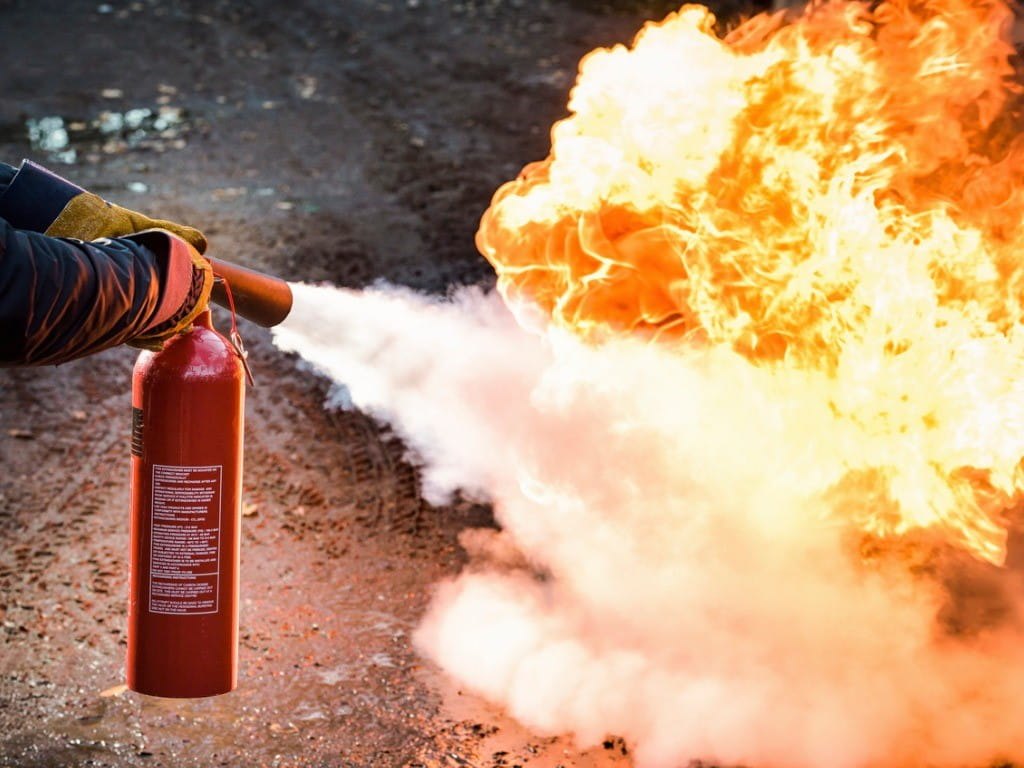
Fire resistance is achieved by the complete assembly, not by individual products. A fire door is rated together with its frame, hinges, closer and hardware; a penetration seal is rated for the specific services that pass through it. Portable extinguishers provide the first response to a small fire and must be matched to the class of fire and positioned so that one is always within reach.
Key components
- Fire-rated doorsets
- Complete door assemblies tested for integrity and insulation.
- Fire dampers
- Close duct openings where ductwork passes through fire-rated construction.
- Penetration firestopping
- Seals, collars, pillows and mortars that restore the rating around services.
- Cable coatings
- Retard flame spread along cable runs in galleries and risers.
- Portable extinguishers
- Water, foam, powder, CO2, clean agent and wet chemical types.
- Signage and registers
- Identification, tagging and records for every item.
Extinguisher selection by fire type
| Fire type | Extinguisher |
|---|---|
| Ordinary combustibles | Water, foam or multipurpose powder, for wood, paper, textiles and plastics. |
| Flammable liquids | Foam, powder, CO2 or clean agent. |
| Flammable gases | Powder, CO2 or clean agent, alongside isolation of the gas supply. |
| Combustible metals | Specialised metal-fire powders. |
| Electrical equipment | CO2 and clean-agent extinguishers that do not conduct electricity. |
| Cooking oils and fats | Wet chemical extinguishers for commercial kitchens. |
Engineering considerations
Compartment strategy
Fire-resistance periods defined by the building's occupancy, height and escape design.
Tested details
Every product installed exactly as tested and certified, without substitution.
Service coordination
Penetration schedules agreed with electrical and mechanical contractors.
Extinguisher distribution
Type, rating and travel distance set in accordance with IS 2190:2024.
Inspection access
Seals and dampers installed so they can be inspected and tested.
Documentation
Certificates and registers ready for fire authority and insurer inspection.
Typical applications
- Staircases, lift lobbies and refuge areas
- Cable and service penetrations through walls and floors
- Electrical rooms and cable galleries
- All occupied buildings, for first-aid firefighting
Fire-resistance ratings and extinguisher types are determined by the space and the hazard.
Scope of delivery
Survey
Compartment walls, openings and existing fire ratings.
Selection
Rated doors, dampers, sealants and extinguisher types.
Installation
Doors, dampers and firestopping fitted to tested details and certified.
Extinguisher servicing
Inspection, recharging and hydrostatic testing.
Records
Tagging and a register entry for every extinguisher.
Owner responsibilities
Most inspection findings trace back to simple checks missed between service visits. The items below fall to the owner; every WATERWEB maintenance report adds the checks specific to the site.
- Keep fire doors closed; never wedge them open
- Keep extinguishers mounted, visible and unobstructed
- Check extinguisher pressure gauges monthly
- Seal any new penetrations through fire-rated walls


Frequently asked questions
How often do extinguishers require servicing?
IS 2190:2024 sets inspection, maintenance and hydrostatic test intervals by extinguisher type, along with a maximum service life. Each site's maintenance schedule lists the due dates for every unit.
Which extinguisher is required?
Selection depends on what could burn: ordinary combustibles, flammable liquids or gases, electrical equipment, metals or cooking oils. WATERWEB specifies the type and quantity for each area.
Planning a new facility, or assessing an existing system?
A WATERWEB engineer will review your drawings or survey the site, assess it against the governing code and set out recommendations in writing.