
Foam systems
Engineered protection for flammable liquids, from fuel stores to hangars.
WATERWEB designs and installs foam systems for fuel and oil storage, tank farms, loading gantries, diesel generator rooms, solvent stores and aircraft hangars, with proportioning and discharge equipment selected for the specific liquid and the space it occupies.
Overview
Flammable-liquid fires behave differently from fires in ordinary combustibles. Water alone can spread burning fuel rather than extinguish it. Foam works by forming a stable blanket across the liquid surface, separating the fuel from oxygen, suppressing flammable vapour and cooling the fuel beneath.
The concentrate, expansion ratio, proportioning method and application rate must each be chosen for the fuel involved. Polar solvents such as alcohols break down ordinary foams and require alcohol-resistant concentrates. The industry is also moving away from fluorinated foams, so new installations should be designed with that transition in mind.
2030
is when the European Union's restriction on per- and polyfluoroalkyl substances (PFAS) in firefighting foams takes effect for most uses, accelerating the global shift to fluorine-free concentrates.
How it works
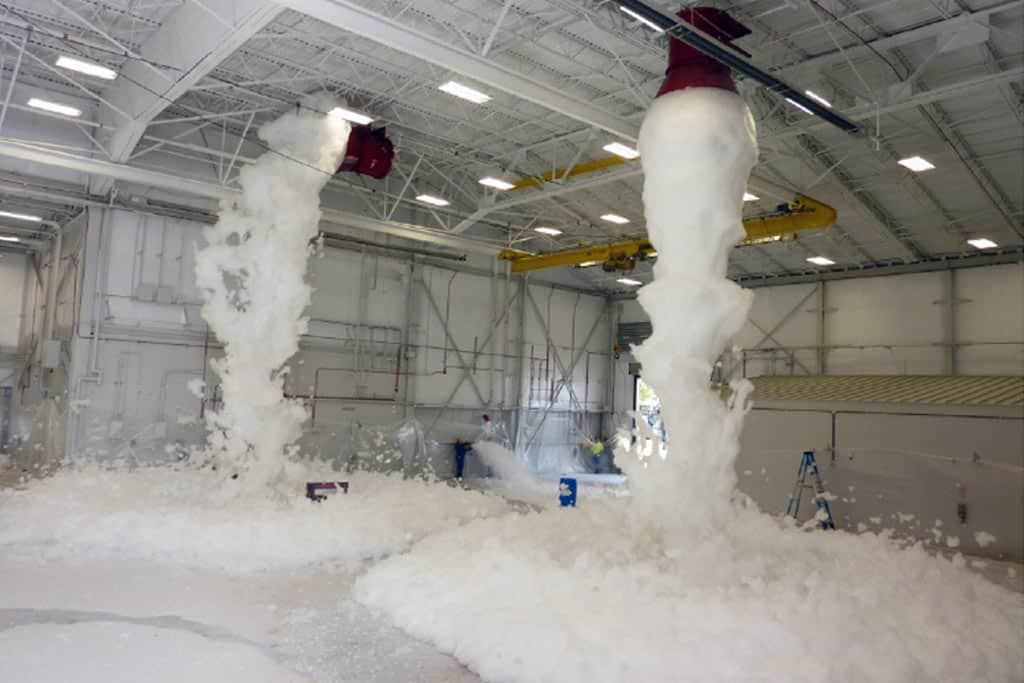
A proportioner mixes foam concentrate into water at a fixed ratio, typically 1, 3 or 6 per cent. The resulting foam solution is aerated at the discharge device to produce finished foam. It is then applied through pourers on storage tanks, monitors and hose lines over open areas, foam-water sprinklers above gantries and pump rooms, or high-expansion generators that fill an enclosed volume.
Key components
- Concentrate storage
- Atmospheric or bladder tanks holding the site's full concentrate requirement.
- Proportioner
- Bladder, balanced-pressure or in-line inductor, selected for flow range and concentrate viscosity.
- Foam chambers and pourers
- Deliver foam gently onto the surface of fixed-roof storage tanks.
- Rim-seal protection
- Detection and foam application at the seal of floating-roof tanks.
- Monitors and branch pipes
- High-capacity application over bunds, spills and open process areas.
- Foam-water deluge
- Open-head foam-water discharge over loading gantries, pump houses and hangars.
- High-expansion generators
- Fan-driven units sized to fill the enclosure within the required time.
Foam types
| Type | Application |
|---|---|
| Low expansion | Storage tanks, bunds and loading gantries, where foam must be projected and resist fuel pick-up. |
| Medium expansion | Vapour suppression over spill areas and bunds. |
| High expansion | Total-volume filling of hangars, warehouses and basements. |
| Alcohol-resistant concentrates | Polar solvents and ethanol-blended fuels. |
| Fluorine-free concentrates | Synthetic alternatives to aqueous film-forming foam (AFFF), increasingly specified by multinational clients and insurers. |
Engineering considerations
Fuel characterisation
Liquid type, flash point and polarity determine the concentrate and application method.
Application rate and duration
Set by the governing standard for the tank, spill or enclosure protected.
Proportioning accuracy
Equipment selected to hold concentration within tolerance across the full flow range.
Concentrate compatibility
Viscosity and chemistry matched to proportioners and discharge devices, particularly for fluorine-free foams.
Total water demand
Cooling of exposed tanks and supplementary hose streams included in the water supply design.
Sector standards
OISD requirements applied where the facility falls within the oil and gas sector.
Typical applications
- Diesel and fuel oil storage
- Solvent, paint and chemical stores
- Tank farms and loading gantries
- Aircraft hangars and vehicle depots
Application rates and durations follow NFPA 11, IS 12835 or OISD, as applicable.
Scope of delivery
Hazard study
Liquid type, spill area and required application rate.
Design
Proportioning method, foam concentrate and discharge devices.
Installation
Foam tanks, proportioners, pourers, monitors and generators.
Commissioning
Foam quality and discharge tests on completion.
Maintenance
Concentrate sampling and proportioner inspection.
Owner responsibilities
Most inspection findings trace back to simple checks missed between service visits. The items below fall to the owner; every WATERWEB maintenance report adds the checks specific to the site.
- Maintain foam concentrate at the specified level
- Submit concentrate samples for testing as scheduled
- Keep monitors and pourers free to operate
- Notify WATERWEB of any new fuel or chemical stored on site


Frequently asked questions
Does foam concentrate have a shelf life?
Yes. Concentrate degrades with age, heat and contamination. Samples are tested periodically, and the concentrate is replaced when it no longer meets specification.
Are fluorine-free foams available?
Yes. Fluorine-free concentrates are progressively replacing legacy AFFF formulations. WATERWEB advises on a concentrate suited to the hazard and the applicable approvals.
What does a transition to fluorine-free foam involve?
More than a change of concentrate. Application rates, proportioner suitability and discharge devices must be re-verified, and existing tanks and pipework cleaned thoroughly. WATERWEB assesses existing systems and plans the transition.
Planning a new facility, or assessing an existing system?
A WATERWEB engineer will review your drawings or survey the site, assess it against the governing code and set out recommendations in writing.