
Sprinkler systems
Automatic control at the point of origin, before a fire can grow.
WATERWEB designs, installs, commissions and maintains automatic sprinkler systems engineered to IS 15105:2021 and, where specified, NFPA 13, from high-rise towers and basements to warehouses, industrial plants and data centres.
Overview
Automatic sprinklers have the strongest track record of any fire protection available to building owners. Each sprinkler responds independently to the heat of a fire directly beneath it, discharging water only where it is needed and holding the fire in check until it is extinguished or the fire service arrives.
The engineering challenge lies in matching the system to the hazard. Occupancy, storage height, commodity, ceiling geometry and obstructions all influence design density and water demand, and each of these can change over a building's life. WATERWEB designs to the hazard as it exists, and revalidates the design whenever a fit-out or change of use alters it.
92%
is the share of fires large enough to activate sprinklers in which they operated. Where they did not, the leading cause was a system that had been shut off, a management failure that disciplined maintenance prevents.
How it works
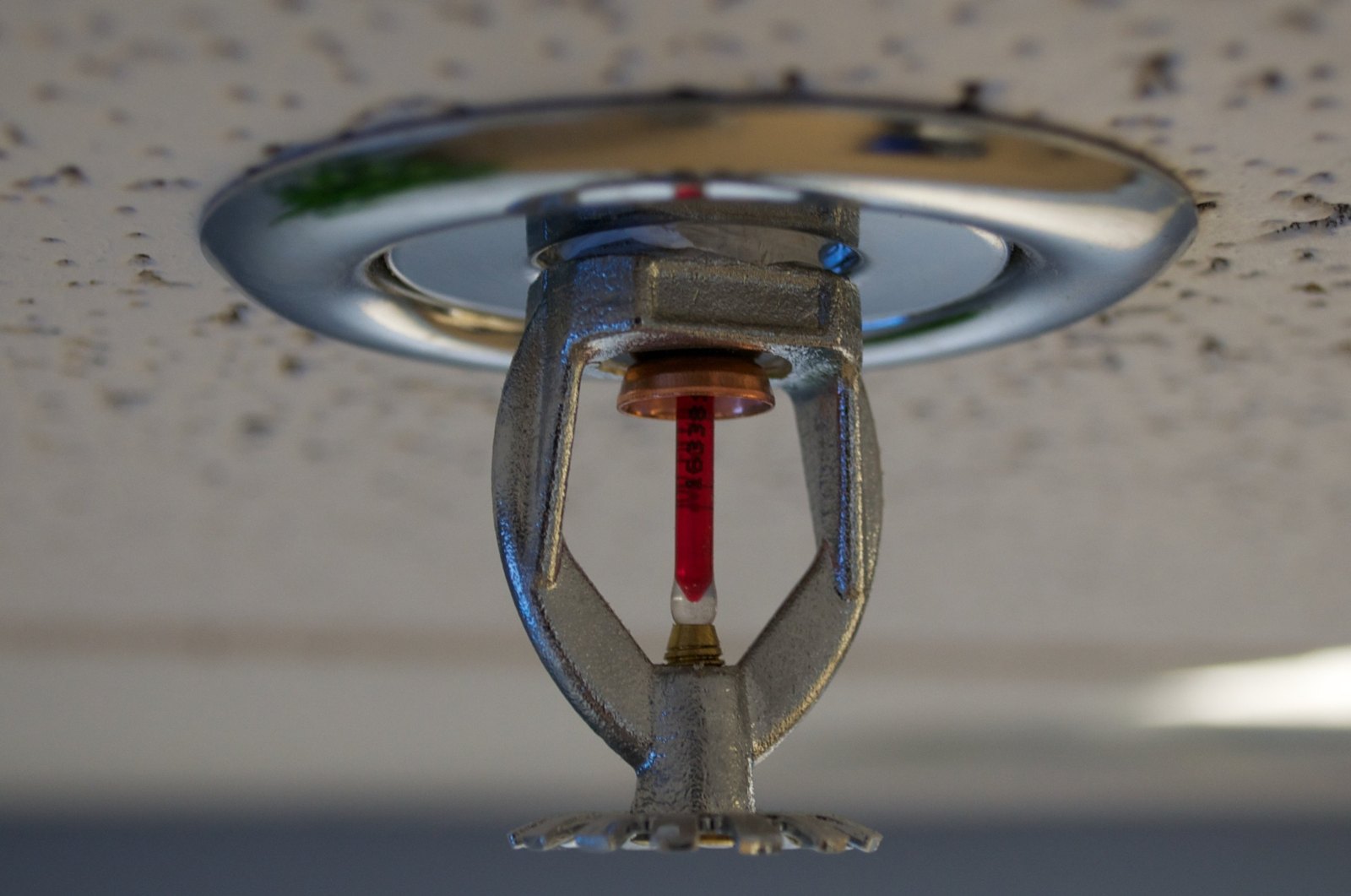
Each sprinkler is sealed by a heat-sensitive glass bulb or fusible link. When the surrounding air reaches the element's rated temperature, that sprinkler alone opens and discharges water in a controlled pattern over the fire. Water flowing through the installation control valve raises an alarm locally and at the fire panel, while the fire pumps start automatically to sustain pressure. In most fires only a small number of sprinklers operate, limiting both fire damage and water damage.
Key components
- Sprinklers
- Temperature-rated heads in pendent, upright and sidewall patterns, with standard or fast response.
- Installation control valve set
- Alarm valve, water-motor gong, pressure gauges and test-and-drain arrangement.
- Flow and supervisory switches
- Signal water flow and valve position to the fire alarm panel.
- Distribution pipework
- Mains, cross-mains and branch lines, hydraulically sized to the design area.
- Fire pumps and water storage
- Sized for the design density, area of operation and required duration.
- Test and drain connections
- Allow flow, alarm and water-supply performance to be proven in service.
Configurations
| Type | Application |
|---|---|
| Wet pipe | Water-filled at all times; the simplest and most reliable arrangement, and the default for most buildings. |
| Dry pipe | Charged with compressed air or nitrogen, for cold stores and other areas where pipework could freeze. |
| Pre-action | Water admitted only after detection operates; widely specified for data centres, archives and control rooms. |
| Deluge | Open sprinklers discharging together, for high-challenge hazards that demand immediate, total wetting. |
| Storage protection | Configurations for high-piled and rack storage, including early suppression, fast response (ESFR) sprinklers where specified. |
Engineering considerations
Hazard classification
Occupancy and commodity classification set the design density and the assumed area of operation.
Hydraulic calculation
Flow and pressure verified at the most demanding area against pump curves and storage.
Water supply duration
Storage sized to sustain the design flow for as long as the hazard class requires.
Temperature rating
Sprinkler ratings selected against the maximum ambient temperature of each space.
Coordination
Head positions coordinated with ducts, cable trays, lighting and structure to keep spray patterns clear.
Future change
Documentation and design margins that allow fit-outs to be assessed quickly and correctly.
Typical applications
- High-rise buildings, 21 m and above in Karnataka
- Basements used for parking or storage
- Large retail, office and assembly floor plates
- Warehouses and many industrial occupancies
Sprinkler requirements are determined by height, occupancy and floor area under NBC 2016, Part 4.
Scope of delivery
Survey and design
Hazard classification, head layout and pipe routing, with computer-aided design (CAD) drawings.
Hydraulic calculation
Every pipe sized, and pump and tank capacity proven against the design demand.
Supply
Listed heads, valves and pipework from approved manufacturers.
Installation and testing
Installation, pressure testing, flushing and commissioning, with a complete handover dossier.
Maintenance
Scheduled inspection and reporting under an annual maintenance contract.
Owner responsibilities
Most inspection findings trace back to simple checks missed between service visits. The items below fall to the owner; every WATERWEB maintenance report adds the checks specific to the site.
- Keep all control valves open and secured
- Maintain clearance between stored goods and sprinkler heads
- Record installation pressure gauge readings weekly
- Report painted, damaged or obstructed heads
- Notify WATERWEB before any fit-out or change of use
- Keep the pump house secured and accessible
Industries served
View projects


Frequently asked questions
Do all sprinklers discharge at once?
No. In a standard wet-pipe system, only the sprinklers heated to their rated temperature operate. NFPA data show that in most fires where sprinklers operated, a single sprinkler controlled the fire. Deluge systems, used for specific high hazards, are the exception.
How often does a sprinkler system require inspection?
Inspection tasks are scheduled weekly, quarterly and annually, with internal pipework assessments at longer intervals. Each site's maintenance schedule sets out every task and its frequency.
Can sprinklers be retrofitted in an existing building?
Yes. WATERWEB assesses the structure, water storage and pump capacity, then designs a retrofit that can be installed while occupied floors remain in operation.
Planning a new facility, or assessing an existing system?
A WATERWEB engineer will review your drawings or survey the site, assess it against the governing code and set out recommendations in writing.