
CO2 and clean-agent suppression
Extinguishment without water, for assets that cannot be exposed to it.
WATERWEB designs and installs carbon dioxide (CO2) systems for generators, turbines and unoccupied machinery spaces, and clean-agent and inert-gas systems for data centres, control rooms, switchgear rooms and archives, complete with detection, release control and enclosure integrity verification.
Overview
For generators, electrical switchgear, servers and irreplaceable records, water can cause damage as costly as the fire itself. Gaseous systems extinguish fire by flooding the protected enclosure with an agent that leaves no residue, allowing equipment to return to service quickly after a discharge.
Agent selection is a safety decision as much as a technical one. Carbon dioxide is highly effective and has served power generation for decades, but it is lethal at extinguishing concentrations and must be confined to spaces from which people can be excluded. Clean agents and inert gases are suitable for normally occupied spaces at their design concentrations. WATERWEB selects the agent according to the hazard, the occupancy, the enclosure and the client's environmental commitments.
10 min
is the minimum hold time NFPA 2001 sets for an effective clean-agent concentration, which a door fan test verifies at commissioning.
How it works
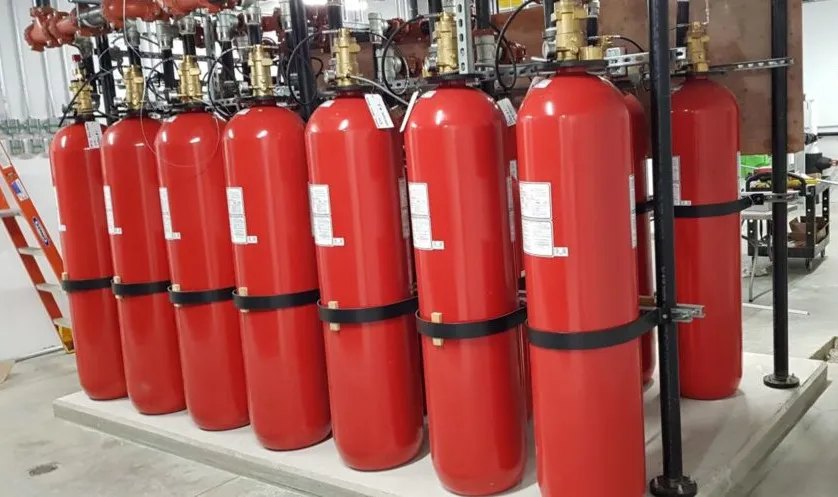
Detection within the enclosure, typically arranged so that two independent detectors must operate, initiates a pre-discharge alarm and time delay. Ventilation is shut down and openings are closed before the agent is released from its cylinders and carried through a pipe network to engineered nozzles. The agent reaches its design concentration rapidly and is held long enough to prevent re-ignition. Abort and manual release controls, lock-off arrangements and discharge indication complete the system.
Key components
- Agent storage
- Cylinder banks with valves, manifolds and weight or pressure monitoring.
- Pipework and nozzles
- Engineered to distribute the agent evenly throughout the enclosure.
- Release control panel
- Dedicated detection circuits, time delays, abort and manual release.
- Pre-discharge warnings
- Sounders, strobes and signage to clear the space before discharge.
- Lock-off and safety devices
- Mandatory for CO2, preventing discharge while personnel are inside.
- Pressure relief
- Venting that protects the enclosure structure during inert-gas discharge.
Configurations
| Type | Application |
|---|---|
| Carbon dioxide (CO2) | Total flooding or local application for generators, turbines and unoccupied machinery spaces. |
| Fluorinated clean agents | Compact storage for occupied rooms such as data centres and control rooms. |
| Inert gases | Nitrogen and argon blends with zero global warming potential, suited to larger rooms and longer pipe runs. |
Engineering considerations
Agent selection
Weighed against occupancy, enclosure size, storage space and environmental policy.
Design concentration
Calculated for the fuel and fire class, including the safety margins the standard requires.
Enclosure integrity
Openings, penetrations and dampers sealed so the room holds its concentration.
Life safety
Time delays, lock-offs, warnings and entry procedures, particularly for CO2.
Acoustic effects
Discharge noise managed in data centres, where it can affect hard disk drives.
Future supply
Agent availability and regulation considered across the system's service life.
Typical applications
- Generators, turbines and alternators
- Server, uninterruptible power supply (UPS) and battery rooms
- Control rooms, switchgear rooms and archives
- Special-purpose machinery and printing presses
Agent quantity is calculated room by room from the enclosure volume and the design concentration.
Scope of delivery
Hazard study
Enclosure volume, openings, occupancy and agent selection.
Design
Agent quantity, cylinder bank, pipework and nozzle layout.
Detection and release
Detectors, warning devices, and abort and manual release controls.
Enclosure integrity
Door fan testing to verify agent retention.
Maintenance
Cylinder weighing, hose inspection and control testing.
Owner responsibilities
Most inspection findings trace back to simple checks missed between service visits. The items below fall to the owner; every WATERWEB maintenance report adds the checks specific to the site.
- Maintain enclosure integrity: keep doors closed and seal new penetrations
- Train personnel to evacuate promptly on alarm
- Never leave the system isolated after maintenance
- Notify WATERWEB before altering the room layout or openings
Industries served
View projects

Frequently asked questions
Is CO2 safe for occupants?
No. CO2 displaces oxygen and is lethal at design concentrations. It is used only where personnel can be excluded or evacuated before discharge, supported by alarms, time delays and lock-off arrangements.
Which agent is best suited to a server room?
Clean agents or inert gases are the standard choice where personnel may be present. WATERWEB evaluates the options against enclosure size, performance requirements and budget.
What is an enclosure integrity test?
A door fan test that measures the leakage of the protected room, verifying that it will retain the agent for the required hold time.
Planning a new facility, or assessing an existing system?
A WATERWEB engineer will review your drawings or survey the site, assess it against the governing code and set out recommendations in writing.